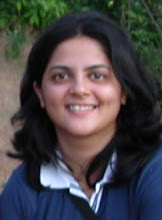
Puran Singh, the guide, was quite ahead of me when he suddenly halted, turned around and beckoned me forward quickly. “Kya hua?”, I asked as I started running. He put a finger on his lips and asked me to be quiet. When I reached him, he was crouching on the ground. He pointed underneath the bushes on the side of the road. I first saw a flash of yellow. Then I saw a little face topped by 2 tiny ears. What a cute cat! I must’ve said that aloud. Puran Singh was scandalized. “Cat! That’s a leopard cub!” he exclaimed! “Wow!” I was fascinated.
I waved my arms to ask the others to hurry up. As 3-4 of the others caught up with us, the cub defiantly stared back at us. But when Puran Singh lifted a few branches to get a photo the cub disappeared into the bushes. I was suddenly struck by a doubt. “Puran Singh, if this cub’s here, where’s his mom?” “Must be round somewhere”, he replied coolly. “What!” I squawked. “Have you gone nuts? We are standing here admiring the cub while his mom must be licking her chops!” I now remembered Man-eaters of Kumaon and Jim Corbett and realized only then that, hell, we are in Kumaon. Brilliant, Watson!
We saw neither hide nor hair of a leopard again. But that evening, the sight of that cute little cub acted like a shot of adrenaline and I literally flew over the track.
But I was stumped when we reached the rock slide. A furious mountain stream had already changed course and was now directly flowing across our route. It was at least 10 feet wide and so fast that to step into it would’ve been suicide. There were 2-3 big rocks jutting out of the water. Puran Singh pushed another rock into the stream close to the edge and jumped onto it. “Now step on this rock when I go to the next one,” he said. “And hurry; there may be a fresh slide any time.” He gave me a hand as I followed him. Sushrut was right behind me. I was scared. Period. The gradient was so steep it was difficult to stand up straight. I kept expecting a rock to fall on my head anytime. The whole ordeal must’ve taken 2 or 3 minutes, but it felt more like hours.
Once we’d crossed the stream, we could see the original track somewhere ahead but there was no way of reaching it directly. Puran Singh told us to descend along the rock slide and climb up zigzag  from the river side. “And be quick. Before this thing moves again. Go in twos, don’t wait for anyone else. Stop only after you reach the track. Go!” Sachin and I raced down and then up and finally halted, clutching our sides and panting. We waited only to see the next 2 or 3 heads appear and started moving immediately. We were still far from the camp.
from the river side. “And be quick. Before this thing moves again. Go in twos, don’t wait for anyone else. Stop only after you reach the track. Go!” Sachin and I raced down and then up and finally halted, clutching our sides and panting. We waited only to see the next 2 or 3 heads appear and started moving immediately. We were still far from the camp. We trudged along the track as it got darker by the minute. Everyone was nearly exhausted. It was only the 2nd day and we had yet to get acclimatized. The Malpa camp being inoperative, there was no option but to cover the distance in one day. By the time we saw the sign post for Budhi, we were at the end of our tether.
 Even then the camp was a km away. Finally we touched base at 7 pm. The glasses of orange Rasna seemed like nectar.
But the 2 senior members had yet to come. When they arrived at 7.30 pm we gave them a standing ovation.
 The next 2 hours were as harrowing as the previous two. Walking on narrow ledges, the cold wall of the mountain on the left, and the chilled fury of the Kali on the right. By now I had almost become used to the roar of the river. Whenever I needed to catch my breath, I chose the widest possible spot on the ledge to pause. As far as possible I avoided looking at the river. It almost made my head spin to look at the current for longer than a few seconds. I had jokingly remarked to Sahji at the start of the trek, when he warned us about getting too close to the side overlooking the river, that I didn’t even know how to swim. He had given me an odd look and said, “Honestly speaking, if someone had to fall into the river, he wouldn’t get the chance to swim”. Brrr! It sent a shiver up my spine.
  By 4 pm we reached the ITBP (Indo-Tibet Border Police) post at Lamari. The ITBP officers and jawans are very helpful people. They are trained in disaster management. They are on the scene the moment there’s a landslide or rockslide. If a mountain stream has flooded, they arrive with ropes and help you across. They offer you tea and fat crunchy potato chips and warm water to drink. That’s another thing. For the rest of the trek, we drank warm water. You can catch a chill from the regular water.
 They were waiting for us with hot tea when we reached their post. “Arre, aap toh saare jawan log ho! Hum ne socha abhi tak nahin aye matlab sab buddhhe honge.” Very funny! They had been expecting us since 2 pm. Once you enter the inner line area, the ITBP keeps tabs on every single person going to and fro. By the time you cross one post, the next post is informed about how many people, from where, how old, what names, everything. Your permits are checked thoroughly. Since the Tibet border is close, they are extremely vigilant. But absolutely polite. No arrogance while following procedure.
 We now stuck close to each other. No one voiced out the worry that a slip and fall here would not have any kind of a happy outcome. There were no railings to speak of. A few relics from long ago remained. But they had rusted and would likely have fallen over if a butterfly had landed on the thin iron rods.
 In places the overhang shielded us from the cascading water. It was unnerving to look out of the waterfall from the inside. The whole journey was fraught with risks and unrealistic beautiful moments. It seemed as if we were being teased by Mother Nature who alternately shone a hot bright light on us, dazzling our eyes, and then pushed us into a dark recess in the mountain, dunking us in chilled waters.
 The stream that flows keeps changing directions. So we had to walk over a make shift bridge. It was actually nothing but a girder used in construction thrown horizontally over the water. Two 2-inch wide iron rods connected by wires. One foot on the left rod, one foot on the right rod. Throw out your arms and balance over the water. I gained a new respect for acrobats. When my cousin caught me on the other side, I nearly buckled in relief.
 We were walking in loose groups of 3-4 people. Sushrut and I were the first to reach a rickety old wooden bridge on a U-turn, over a milky white, foaming waterfall. I paused to get my snap clicked over the bridge with no railings, made up of a few planks of wood nailed over a few logs of wood. I could see the water crashing a few feet under my shoes, through a few holes in the wood. I gritted my teeth and posed.
 In the next instant we raced back to where he had fallen. The water roiled sickeningly close. Just then, we heard his voice, “Don’t panic, I’m ok”. He had fallen into a few tall shrubs that grew by the side of the river. They broke his fall and he landed on the rocks by the water instead of in the water. He had fallen about 15 - 20 feet below the path.
  Before starting out, we worshipped at the Shiva temple. Sahji lit incense and rang the temple bell, praying for a safe passage. It had been drizzling since we woke up and there was a nip in the air. I wore a sleeveless sweater under the raincoat. The first two kms of plain walking brought us to Jipti. From Jipti there were steep stone steps that rapidly took us down towards Lakhanpur. Local folklore has it that the steps were constructed by a rajasthani Maharajah. There are supposed to be exactly 4,444 of them in number. I can’t vouch for that. I was too busy putting one foot in front of another to count them.
 We were joined by three horses and their grooms. We had hired two for my uncle and aunt as they both are nearly sixty. The third was a backup in case anyone was hurt or too exhausted midway. One of the grooms was a young impertinent bloke. As he overtook me, he said, “Didi, agar aap ghode pe jaana chahoge toh mere ghode pe chalna.” (If you want to go on horseback, take my horse). I was flattered. “Kyun, bhaiyya?” I asked. “Arre didi, aap bhi chhote aur mote, aur mera ghoda bhi. Achchhi jodi hogi.” (Both you and my horse are short and plump. You will make a good pair). I decided that walking faster was a better option than strangling him.
 Climbing down the steps was not as easy as it seemed. By the time we reached reasonably level ground, everybody’s knees were aching. Pallavi and I compared notes and realized that our legs were trembling so much that we were likely to fall over standing still. At one point we passed over an old landslide that was so huge that we felt like little ants. See the tiny red dot in the picture? That’s me.
 The 45-km road from Dharchula to Mangti is made of narrow roads twisting and turning tortuously. The drop into fierce Kali is always just 2-3 feet away. Everywhere you look, the green peaks of the Himalayas are hypnotizing in their tall glory. By then the skies had cleared and everything was drenched in a pale watery sunshine.
 The third and final landslide did not leave us an option. This time the jeeps left us for good. We wouldn’t see any wheels in the area for the next 12 days. This landslide was all slippery mud and rocks. We slipped and slid our way to the other side. The mules took over the luggage. We hefted our smaller backpacks and began walking. Luckily we were only 2-3 kms from the actual starting point, so the extra walking was not so much as we had feared.
 The track from Mangti to Gala is picturesque and fairly easy. In a few places, there were condors circling overhead. Small mountain brooks gushed and gurgled in pretty waterfalls. We filled our bottles and drank the sweet clear water. There is some mica content in the water which can sometimes give you an upset stomach. We didn’t face that problem. Our stomachs were probably lead-lined.
 Milind brushed against a small prickly bush by mistake. In seconds, his hand was covered with angry red blisters which itched like hell. There was also a slight swelling. He held it under a cool stream of water and carried on. After a few hours, the swelling and blisters settled down. The offending plant was locally called ‘bichchhoo’ or scorpion in hindi. We learnt to steer clear of it in future.
 At 3:30 we finally reached the Gala camp. Lunch was a light affair. Piping hot moong and rice khichri with papad and mango pickle. After lunch we sat on the parapet outside camp and gazed down into the valley. There were tiny birds, some red, some yellow, twittering around. The Kali looked harmless and distant from this height.
 The remaining hour before bedtime was spent in frenzied preparations for the next day. Sometime after midnight, it started pouring. I creaked open the door to the balcony and watched the Kali roiling and churning in the faint light reflecting from the clouds. I went back to bed praying for the rain to stop before morning. But anticipation, and a slight apprehension, kept me tossing and turning the whole night through.
 About 45 kms from Kathgodam, we took our first halt at Kainchidham. Here, we found an ashram, dedicated to Shri Neeb Karori Maharaj who is especially revered in north India. The ashram complex had 4 temples, of Vaishno Devi, Ramji, Hanumanji and Shiva. The temples were unique in that they were spotlessly clean. The idols were made of pure white marble and the inner walls of the temples were decorated with fine tapestry in rich colors of yellow, red, blue and gold.
 So we opted for a late and light lunch and made our way to Almora. Almora, in the valley, is pretty. The tiny cottages and lavish bungalows clinging to the cliffside look like a picture postcard. The mountains are covered with tall pine and leafy rhododendrons. Little brooks and mountain streams play hide and seek amongst the rocks and foliage. Puran Singh, our 2nd guide was an expert on the local flora and fauna and pointed out interesting specimen. See the trident-shaped pine in photo.
 A foaming white river called Dhauli Ganga, kept us company towards the end of our journey. The wide expanse of the river, especially when viewed from a height of 500 or so feet was a dizzying sight. But it was just a trailer of things to come. We would soon catch up with a demonic river, the Kali, near Kathgodam. Most of the 230 kms of the trek would be spent walking alongside this river and she would give us nightmares for quite some time.
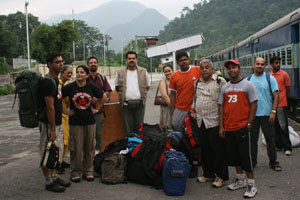 Even there, standing on the platform at the railway station, I could feel the difference in the air. The cold mountain air of Uttaranchal was crisp and the sky was a vivid blue. Adi Kailash, we are on our way, I thought and felt a thrill deep in my bones.