We woke up early feeling completely refreshed. In our exhaustion last evening, we had barely registered that the Om parbat for which we had trekked all this way, was completely obscured by clouds. This morning we were hoping that the weather would clear up enough for us to see the Om. This is indeed one of nature's miracles. The mountain top is usually covered completely with snow. During this time of the year, the snow melts sufficiently to
  reveal an Om shape in snow. The photo here is one I got on the net (courtesy: www.meriyatrra.com).
 We waited for a pretty long time. We chanted Om with all our hearts. Finally the clouds parted to partially reveal the mountain top in the distance. But alas, a lot of the snow had melted and what we saw was a somewhat broken form of the Om. Courtesy: Global Warming. Another one of nature's beautiful and miraculous creations has fallen a victim to it. We all felt saddened and grew a little quiet. Still, we were glad to have made the effort and at least caught a glimpse of the Om. God knows if in future people will even be able to see as much. Perhaps future trekkers may completely bypass this part of the trek. That would be really sad. Anyway, this is what we saw.
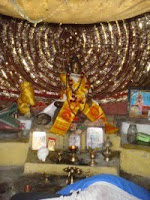 After breakfast everybody went exploring. There was a beautiful little Shiva temple near the camp. Another point of interest was the wreck of a helicopter that's been lying around for a long, long time. This morning we lazed about till lunch. The weather was pleasant, no rain and we were only supposed to climb down to Kalapani and camp there.
Sachin had gotten better through the night but Pallavi was feeling ill. The altitude had given her a headache and she was also feeling nauseous. So Aditya and Pallavi left early, after breakfast. The rest of us had a nice lunch and left at around 12:30. Today, wonder of wonders, I reached camp first and in under 2 hours. There was not a spot of rain and the road was all downhill. After everybody reached the camp, I suffered through a round of highly exaggerated pats on the back.
By then Pallavi had revived completely and now Aditya was sleeping like a log. We ribbed her that perhaps he had had to carry her down the mountain. With the horse.
That day at camp, we had steaming cups of soup and sang endless rounds of songs. Around 6:30 pm, we went to the temple to join in the aarti. We sang bhajans and recited prayers and ate the bhog brought by the jawans. It was a beautiful experience. The whole atmosphere was spiritually charged and we returned to our fibre huts feeling rejuvenated. We went to sleep with the happy thought that tomorrow also was a light day, just the 9 km to Gunji.
 We were happy to have made good speed to Kalapani. The location also was beautiful. The river Kali originates here. There is a fairly big temple built over the spot where the river actually flows out of the earth. You can go inside and see where the water originates from. Additionally there are shrines to Shivji and Kali Maa. The temple is spotlessly clean and well kept. In the evenings the jawans gather in the temple to sing bhajans. Whenever there is a group of trekkers, they are supposed to join in the singing and praying.
 Outside the temple, there are low stone walls built around the small pond formed by the river in front of the temple. The whole courtyard and the approach road are decorated with brightly coloured flags and trishuls. We sat there soaking the sun for quite some time. Again the jawans fed us fat potato chips and hot tea. I stuffed myself. No other chips have ever tasted so good to me.
 The jawans told us - Move. This is going to get worse. It is better if you hit the road. The next 2 kilometers or so are risky. Once you leave camp, run all the way to the bridge ahead. Once you cross the bridge, you should be safe. But till you reach there, don’t slack off and keep watching the mountains.We quickly put on raincoats and came out of the camp. Atul grabbed my hand and said,” Didi, you are the slowest one. Just keep with me. I won’t leave your hand but you have to run like hell. You are not allowed to be tired. We stop when I stay we stop.” I nodded, saving my breath for the run. Believe me, I ran like the hounds of hell were after me. The road was wide enough and firm, so I didn’t worry about slipping and falling. But over the sound of my own labored breathing, I strained to catch a cracking or rumbling that would signify a rock slide but I could hear nothing. Finally, the bridge appeared ahead of us and we slowed down.
 Around 7:15 am, we gulped hot glasses of bourn vita and left the gates of the Gunji camp. Turning right we walked a sharp incline and came to a kind of a plain where again there was an ITBP check post and a head count was done. The sky was a deep blue with puffs of clouds everywhere and everything was bathed in a pale watery light. The air was crisp and clean with a faint piney smell. The walk was pleasant and invigorating. The path was wide and stone strewn and it seemed like we were out on a simple nature trail with no sign of the previous hardships.
 The Kali seemed like a sweet gurgling brook. I found it hard to believe that this was the same river. Sometimes we were high above the river and sometimes we were walking alongside it. We could see cliffs of sandstone on the opposite side and mountains of a yellowish ochre stone on our side and smooth pebbles and rocks along the river. There were moss and lichen covered trees and unusually shaped dried trunks all around. I was lulled into a feeling of tranquility and mostly walked in silence.
 A small battalion of ITBP soldiers raced by us at one point. They were probably out on their exercise routine. A little before Kalapani we saw structures like closed rooms down below the path a little off the river bed. When we asked Sahji, he said those were actually bathrooms. Somewhere below were hot springs and the bathrooms were built for pilgrims to bathe in them. A hot bath sounded heavenly though sadly we were in no position to take advantage of it. We had a lot of ground to cover yet with no time for luxuries.The trek was completely uneventful and almost soothing and we covered the 9 kms to Kalapani by 11:15 am. I should have wondered then at such an out of sync calm but I was too busy enjoying myself to look a gift horse in the mouth.
 This part of the trek was lengthy but nothing to give you butterflies in the stomach. Just keep on walking steadily in a rhythm. We reached Seti by 1:30, had some lunch and pushed off. I did not much feel like eating. Sushrut had a terrible headache. He is prone to migraines and often feels nauseous during a bout. So he had a nap instead of lunch and I woke him up when it was time to move on. He drank a small bottle of Glucon-D and began walking after splashing some water on his face.
 The route was scenic and the trees gave off a pleasant piney aroma. The sand by the river looked bone dry and white. We were walking almost in 2s or 3s and Sushrut and I were pretty much alone. But there was nothing scary about it. Imagine the thrill – to be able to look up at the vast open sky, the tall green mountains, hear a few birds twittering, the river gushing close by, feel the crunch of dry twigs and gravel underfoot, and not have a single soul around! As if all of nature’s splendour were on a display just for your pleasure! It was one of the best parts of the trek for me.
 By 3:30 pm, we were just about 4-5 kms away from Gunji camp. At one point, the Kali turns right and Kuti begins to keep you company. Gunji is situated on the confluence of the two rivers. In the distance, I could see the camp at Gunji. It’s across the river. But there’s only one bridge to reach it. So you keep walking and leave the camp behind on the other side, make a U-turn, cross the bridge and then cover the same distance on the other side and walk down to the camp. It seems like such a waste of time, perhaps because you keep seeing the camp but reach it after almost 1 and 1/2 hrs.
 There is a canteen run by KMVN at the top of Chhialekh. My aunt Lata and Pallavi had reached ahead of us coz of the horses. They were already ensconced in the tiny kitchen frying puris. They said they preferred the toasty warm room to the cold outside. I was happy to help – by eating. Hot puris, potato subzi, pickle, steaming mugs of tea. Heaven! Especially since it was pretty cold up here. There was a strong breeze.


 The next morning dawned cool and fresh. As we looked out from the camp, we saw blue skies sprinkled with gray clouds, and lush green mountains dotted with icy patches of frozen streams. Feeling invigorated, we left camp at sharp 6:45 am after downing glasses of hot bournvita and glucose biscuits.
 Today, I decided to get rid of the backpack. I only carried a waist pouch filled with candied sweets, nuts and chunks of crystal sugar. The pockets of my cargo pants bulged with bottles of water and Glucon-D. My raincoat was tied around my waist. But I found it easier to walk this way.
  On the way we saw colorfully decorated mules, bells jingling around their necks, making their way down the slope.
  As we neared the end of the climb, Sahji caught up with us. He said, “Just a little bit more. Then you will see a meadow full of the most beautiful flowers. Yakeen maniye, saare dukh dard bhool jaaoge”. As we turned the final corner, there was a sign painted in Hindi which said something like – The flower filled valley of Chhialekh awaits you after your strenuous climb. Finally after almost 3 hours of laborious climbing, we reached the Chhialekh meadow at about 9:30 am.
  from the river side. “And be quick. Before this thing moves again. Go in twos, don’t wait for anyone else. Stop only after you reach the track. Go!” Sachin and I raced down and then up and finally halted, clutching our sides and panting. We waited only to see the next 2 or 3 heads appear and started moving immediately. We were still far from the camp.
  Even then the camp was a km away. Finally we touched base at 7 pm. The glasses of orange Rasna seemed like nectar.